
GMSLA
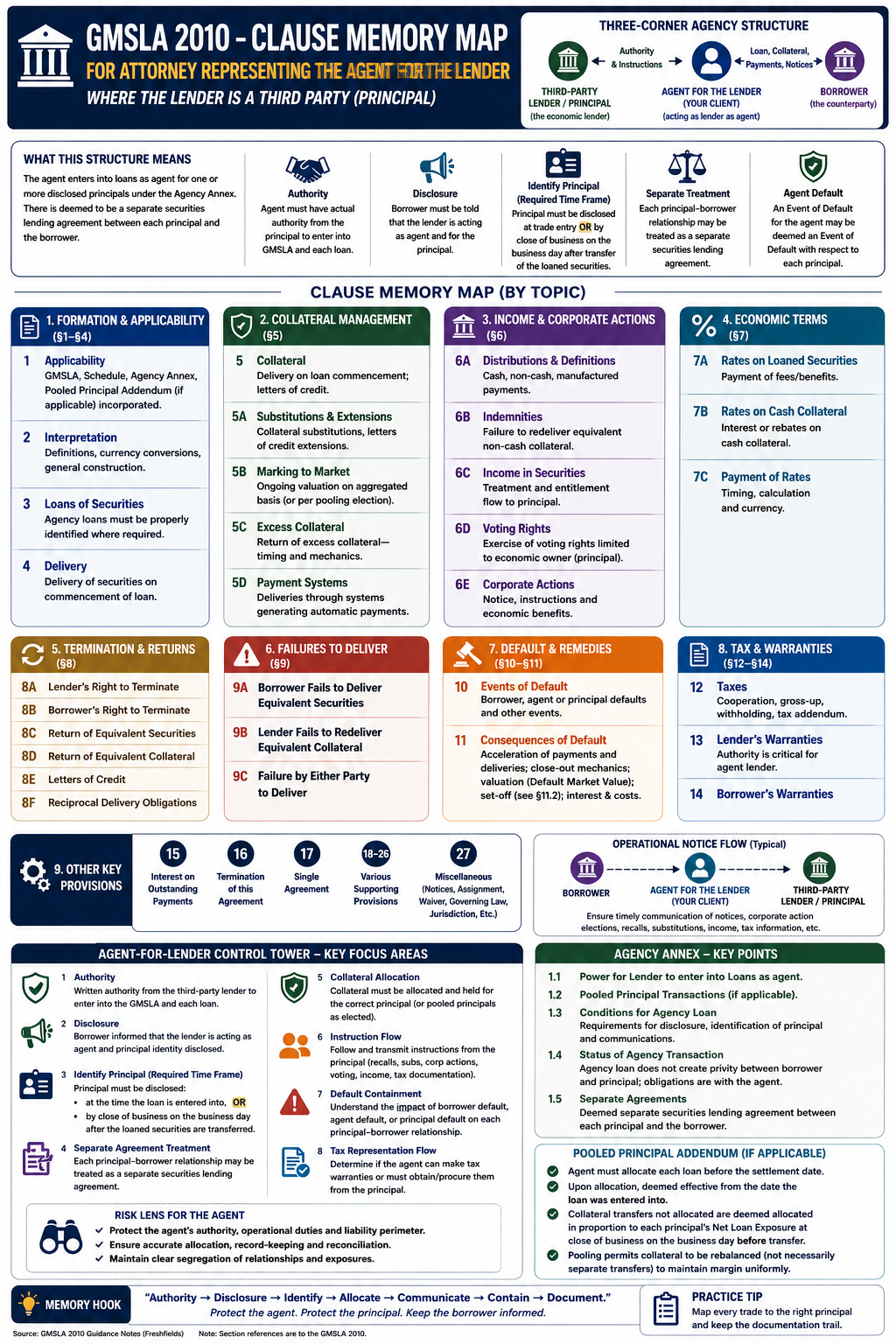
GMSLA 2010 — Clause Memory Map For Attorney Representing the Agent for the Lender
Where the lender is a third party principal
Three-Corner Agency Structure
Lender / Principal
(economic lender)
(your client)
(counterparty)
What this structure means
The agent enters into loans as agent for one or more disclosed principals under the Agency Annex. There is deemed to be a separate securities lending agreement between each principal and the borrower.
Authority
Agent must have actual authority from the principal to enter into the GMSLA and each loan.
Disclosure
Borrower must be told that the lender is acting as agent and for the principal.
Identify Principal
(Required Time Frame)
Principal must be disclosed at trade entry or by close of business on the business day after transfer of the loaned securities.
Separate Treatment
Each principal-borrower relationship may be treated as a separate securities lending agreement.
Agent Default
An Event of Default affecting the agent may also affect the relevant principal arrangement.
§1–§4
Applicability
Ensure GMSLA, Schedule, Agency Annex, Pooled Principal Addendum if applicable are incorporated.
Interpretation
Definitions, currency conversions and general construction.
Loans of Securities
Agency loans must be properly identified where required.
Delivery
Delivery of securities on commencement of loan.
§5
Collateral
Delivery on loan commencement; letters of credit.
Substitutions & Extensions
Collateral substitutions and letter of credit extensions.
Marking to Market
Ongoing valuation on aggregated or loan-by-loan basis.
Excess Collateral
Return of excess collateral, timing and mechanics.
Payment Systems
Deliveries through systems generating automatic payments.
§6
Distributions & Definitions
Cash, non-cash and manufactured payments.
Indemnities
Failure to redeliver equivalent non-cash collateral.
Income in Securities
Treatment and entitlement flow to principal.
Voting Rights
Exercise of voting rights limited to economic owner/principal.
Corporate Actions
Notice, instructions and economic benefits.
§7
Rates on Loaned Securities
Payment of fees and benefits.
Rates on Cash Collateral
Interest or rebates on cash collateral.
Payment of Rates
Timing, calculation and currency.
§8
Lender’s Right to Terminate
Borrower’s Right to Terminate
Return of Equivalent Securities
Return of Equivalent Collateral
Letters of Credit
Reciprocal Delivery Obligations
§9
Borrower Fails to Deliver Equivalent Securities
Lender Fails to Redeliver Equivalent Collateral
Failure by Either Party to Deliver
§10–§11
Events of Default
Borrower, agent for the lender or principal defaults and other events.
Consequences of Default
Acceleration of payments and deliveries; close-out mechanics; valuation; set-off; interest and costs.
§12–§14
Taxes
Cooperation, gross-up, withholding, tax addendum.
Lender’s Warranties
Authority is critical for agent for the lender.
Borrower’s Warranties
9. Other Key Provisions
Interest on Outstanding Payments
Termination of this Agreement
Single Agreement
Various Supporting Provisions
Miscellaneous: notices, assignment, waiver, governing law, jurisdiction, etc.
1. Authority
Written authority from the third-party lender to enter into the GMSLA and each loan.
2. Disclosure
Borrower informed that lender acts as agent and principal identity disclosed.
3. Identify Principal — Required Time Frame
Principal must be disclosed at trade entry, or by close of business on the business day after the loaned securities are transferred.
4. Separate Agreement Treatment
Each principal-borrower relationship may be treated as a separate securities lending agreement.
5. Collateral Allocation
Collateral must be allocated and held for the correct principal or pooled principals as elected.
6. Instruction Flow
Follow and transmit instructions from the principal on recalls, substitutions, corporate actions, voting, income and tax documentation.
7. Default Containment
Understand the impact of borrower default, agent default or principal default on each loan or principal-borrower relationship.
8. Tax Representation Flow
Determine whether the agent can make tax warranties or must obtain/procure them from the principal.
- Protect the agent’s authority, operational duties and liability perimeter.
- Ensure accurate allocation, record-keeping and reconciliation.
- Maintain clear segregation of relationships and exposures.
Pooled Principal Addendum, if applicable
- Agent must allocate each loan before settlement.
- Upon allocation, deemed effective from the date the loan was entered into.
- Collateral transfers not allocated are deemed allocated in proportion to each principal’s Net Loan Exposure at close of business on the business day before transfer.
- Pooling permits collateral to be rebalanced to maintain uniform margin.
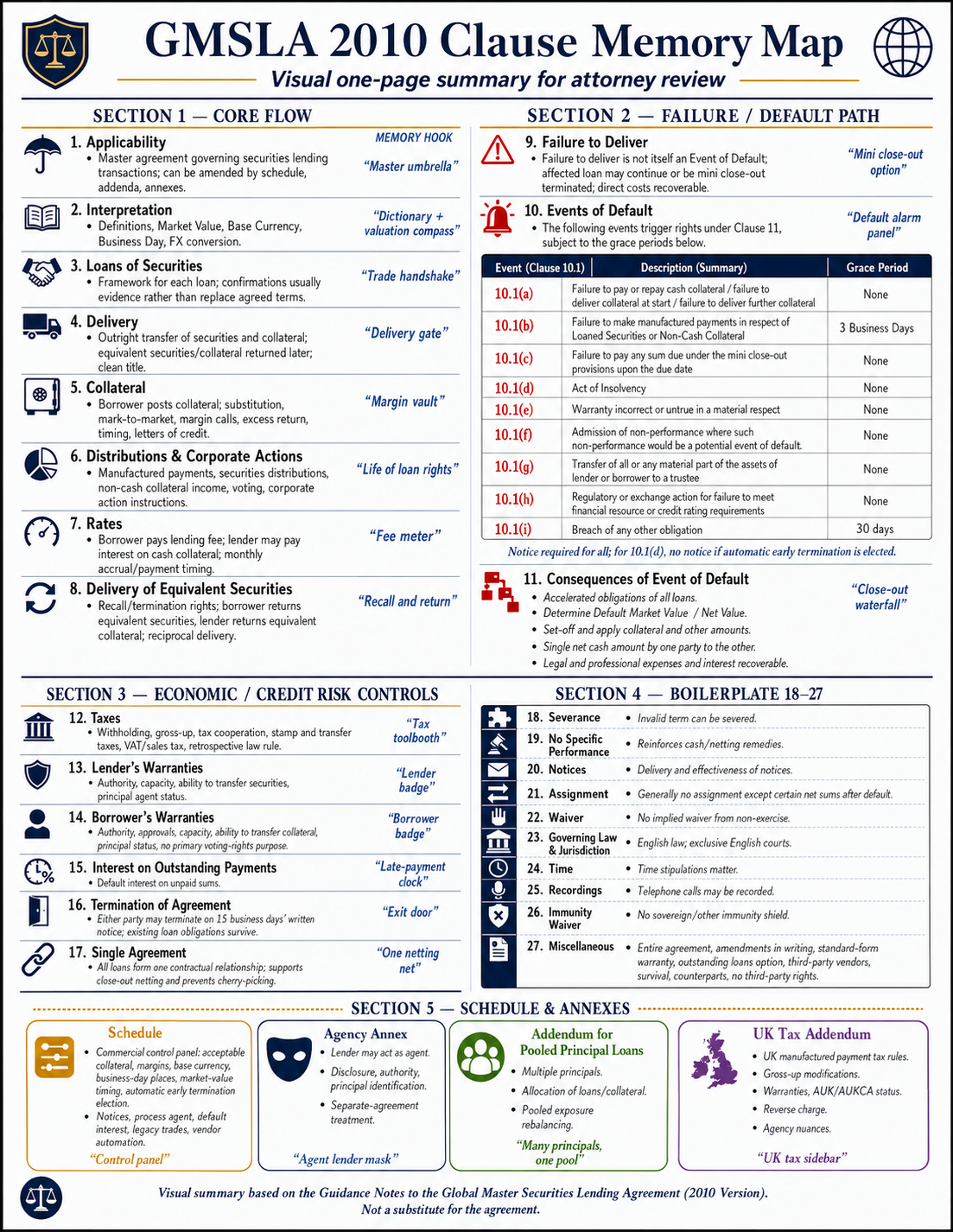
GMSLA 2010 Clause Memory Map
Visual one-page summary for attorney review
Section 1 — Core Flow
1. Applicability
Master agreement governing securities lending transactions; can be amended by schedule, addenda, annexes.
2. Interpretation
Definitions, Market Value, Base Currency, Business Day, FX conversion.
3. Loans of Securities
Framework for each loan; confirmations usually evidence rather than replace agreed terms.
4. Delivery
Outright transfer of securities and collateral; equivalent securities/collateral returned later; clean title.
5. Collateral
Borrower posts collateral; substitution, mark-to-market, margin calls, excess return, timing, letters of credit.
6. Distributions & Corporate Actions
Manufactured payments, securities distributions, non-cash collateral income, voting, corporate action instructions.
7. Rates
Borrower pays lending fee; lender may pay interest on cash collateral; monthly accrual/payment timing.
8. Delivery of Equivalent Securities
Recall/termination rights; borrower returns equivalent securities, lender returns equivalent collateral; reciprocal delivery.
Section 2 — Failure / Default Path
9. Failure to Deliver
Not itself an Event of Default; affected loan may continue or be mini close-out terminated; direct costs recoverable.
10. Events of Default
Events below trigger Clause 11 rights, subject to grace periods.
| Event | Description | Grace |
|---|---|---|
| 10.1(a) | Failure to pay/repay cash collateral; failure to deliver start or further collateral. | None |
| 10.1(b) | Failure to make manufactured payments for loaned securities or non-cash collateral. | 3 Business Days |
| 10.1(c) | Failure to pay sums due under mini close-out provisions. | None |
| 10.1(d) | Act of Insolvency. | None |
| 10.1(e) | Warranty incorrect or untrue in a material respect. | None |
| 10.1(f) | Admission of non-performance where it would be a potential default. | None |
| 10.1(g) | Transfer of material assets to a trustee. | None |
| 10.1(h) | Regulatory/exchange action for failure to meet financial resources or credit rating requirements. | None |
| 10.1(i) | Breach of any other obligation. | 30 days |
Notice required for all; for 10.1(d), no notice if automatic early termination is elected.
11. Consequences of Event of Default
Accelerate obligations; determine Default Market Value / Net Value; set off; single net cash amount; legal/professional expenses and interest recoverable.
Section 3 — Economic / Credit Risk Controls
12. Taxes
Withholding, gross-up, tax cooperation, stamp and transfer taxes, VAT/sales tax, retrospective law rule.
13. Lender’s Warranties
Authority, capacity, ability to transfer securities, principal/agent status.
14. Borrower’s Warranties
Authority, approvals, capacity, ability to transfer collateral, principal status, no primary voting-rights purpose.
15. Interest on Outstanding Payments
Default interest on unpaid sums.
16. Termination of Agreement
Either party may terminate on 15 business days’ written notice; existing loan obligations survive.
17. Single Agreement
All loans form one contractual relationship; supports close-out netting and prevents cherry-picking.
Section 4 — Boilerplate 18–27
Section 5 — Schedule & Annexes
Schedule
- Acceptable collateral, margins, base currency, business-day places.
- Market-value timing, automatic early termination election.
- Notices, process agent, default interest, legacy trades, vendor automation.
Agency Annex
- Lender may act as agent.
- Disclosure, authority, principal identification.
- Separate-agreement treatment.
Addendum for Pooled Principal Loans
- Multiple principals.
- Allocation of loans/collateral.
- Pooled exposure rebalancing.
UK Tax Addendum
- UK manufactured payment tax rules.
- Gross-up modifications.
- Warranties, AUKI/AUKCA status.
- Reverse charge and agency nuances.